Short answer: Missed calls cost contractors their weekly missed calls × the share that were real jobs × close rate × average job value, times 52 for a year. With example numbers (10 calls, 40%, 50%, $450), that's $46,800 a year in lost revenue. Fix it with routing, text-back, after-hours coverage, chat, accurate Google hours and booking.
Key takeaways
- Use your own numbers. Industry averages won't match your call volume, close rate or ticket size.
- The result is lost revenue, not profit, and it leaves out repeat business and referrals.
- Start with the cheapest fixes: accurate Google hours and missed-call text-back.
- Re-run the calculator in 60 days to see what the fixes are earning you.
You're on a roof, under a house or driving between jobs, and the phone rings. You can't get it. By the time you call back, the homeowner has already booked someone else. It happens a few times a week, and it's easy to shrug off. But how much do missed calls cost contractors like you over a full year?
Industry averages won't tell you, because your call volume, close rate and ticket size are your own. So instead of borrowing someone else's numbers, this guide gives you a four-number calculator to run with yours, then six practical fixes, from simple call routing to website booking, so fewer calls slip through.
How Do You Calculate What Missed Calls Cost?
Multiply four of your own numbers: missed calls per week, the share that were real jobs, your close rate and your average job value. Then multiply by 52. Grab your phone log and your job records. You need four numbers:
A. Missed calls per week. Check your phone system or carrier call log for unanswered calls. Count only calls that never got a live answer and didn't get a callback before the person moved on. If you don't know, track it for two weeks.
B. Percent of those calls that were real job opportunities. Not every missed call is a customer. Some are vendors, spam or existing customers with a quick question. Look at the voicemails and callbacks you did return and estimate what share were new work.
C. Your close rate on new-job calls. Out of every 10 new-job calls you do answer, how many turn into a booked, paid job?
D. Your average job value. Your average invoice for a typical service call or job. Use your accounting software or invoices from the last few months.
The formula:
Weekly lost revenue = A × B × C × D
Yearly lost revenue = weekly lost revenue × 52
That's revenue, not profit, and it doesn't count repeat business or referrals those customers might have brought. So the real cost is usually higher than the number you get.
How Much Do Missed Calls Cost Contractors? A Worked Example
In this example, made-up numbers come to $900 a week, or $46,800 a year, in lost revenue.
Example data only. These numbers are made up to show how the math works. They are not industry averages. Use your own.
| Input | Example value |
|---|---|
| A. Missed calls per week | 10 |
| B. Share that were real job opportunities | 40% |
| C. Close rate on new-job calls | 50% |
| D. Average job value | $450 |
Weekly lost revenue = 10 × 0.40 × 0.50 × $450 = $900
Yearly lost revenue = $900 × 52 = $46,800
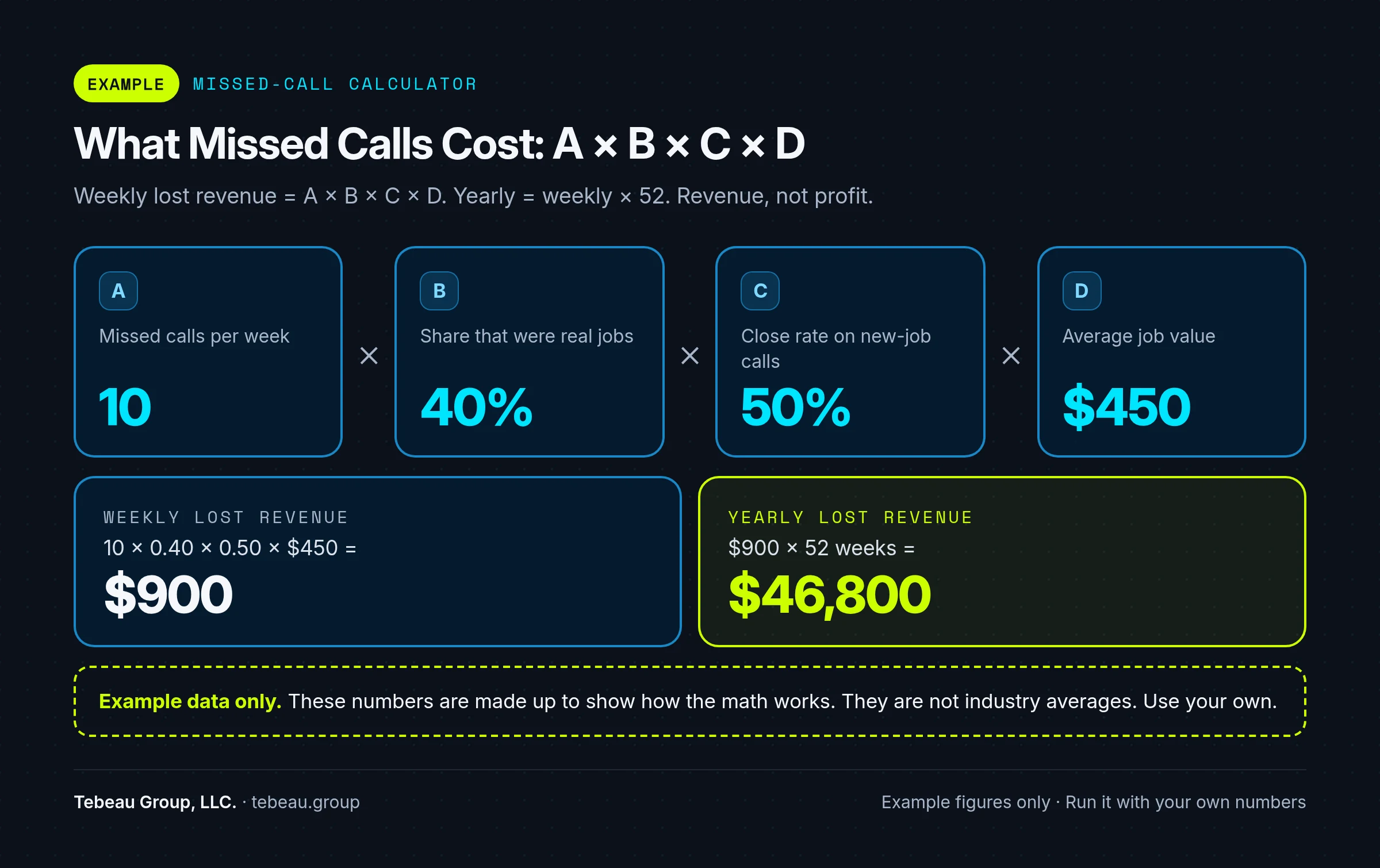
In this example, two jobs a week are walking out the door. Run your own numbers. If the result is bigger than what it would cost to fix the problem, the fix pays for itself.
How Can Contractors Stop Missing Calls? 6 Fixes
Use call routing, missed-call text-back, after-hours coverage, a website chatbot, accurate Google hours and online booking.
1. Call routing
The problem: Every call rings one phone, usually the owner's.
The fix: Set up routing so calls ring the office first, then roll to a second person or a group of phones if nobody answers. Most business phone systems and VoIP services support ring groups, business-hours schedules and overflow rules. Track which numbers and pages calls come from so you know where your leads start.
2. Missed-call text-back
The problem: Most callers who hit voicemail don't leave a message.
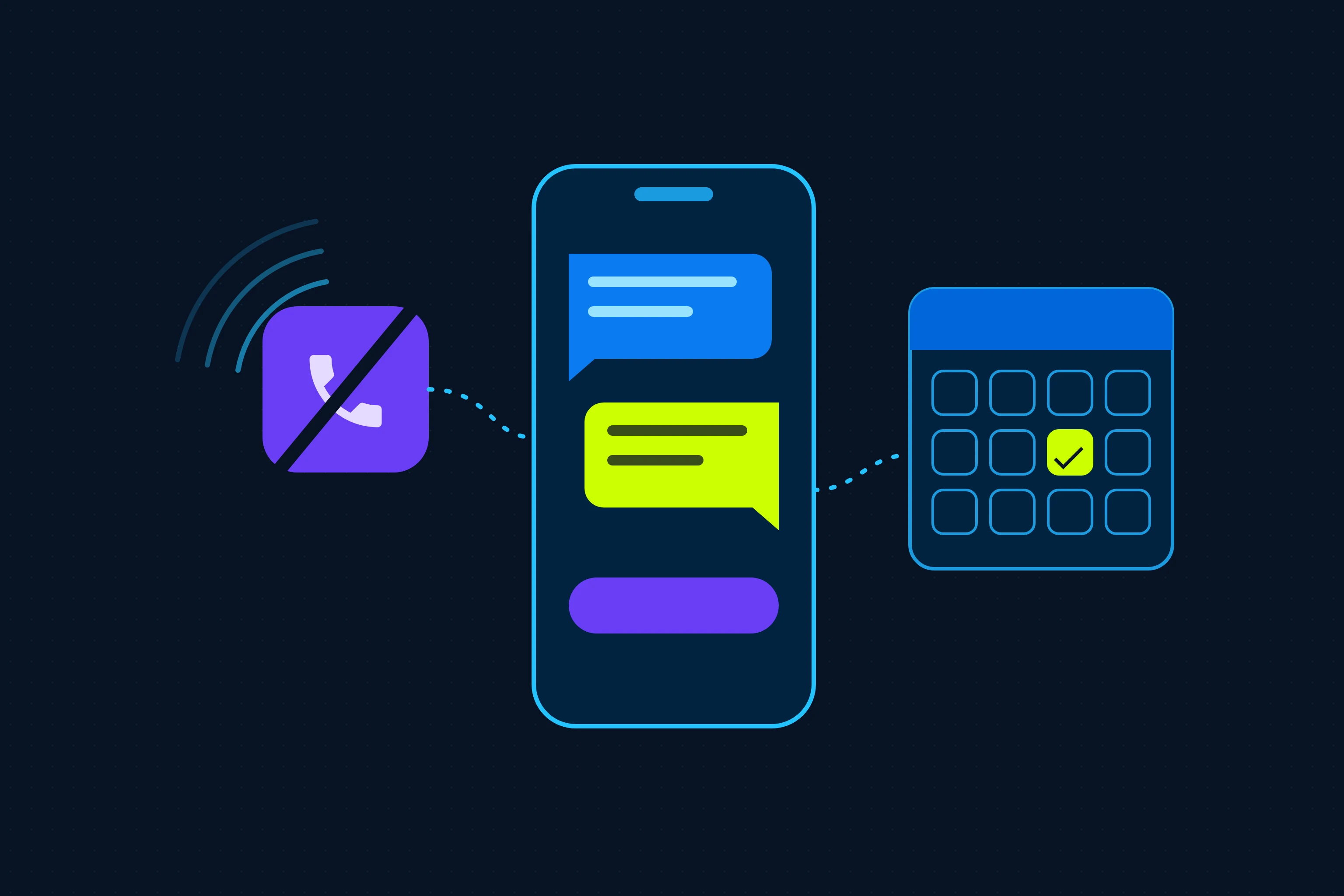
The fix: Send an automatic text within a minute of a missed call: "Sorry we missed you. This is [Company]. What can we help with? Reply here or book online: [link]." It keeps the conversation going while you finish the job in front of you. If you text from a business number, ask your phone provider about carrier registration for business texting (often called 10DLC) so your messages get delivered.
3. After-hours coverage
The problem: Emergencies don't wait for business hours. Calls at night and on weekends go to voicemail.
The fix: Use an answering service, an on-call rotation, or an AI receptionist that can answer, collect the details, triage urgency and book or escalate. Decide in advance which calls get a tech dispatched tonight and which get booked for the morning.
4. A website chatbot
The problem: Some customers would rather type than call, especially at night or at work.
The fix: Add a chatbot that answers common questions, collects contact details and the problem, and offers appointment times. Keep it honest and simple. Nielsen Norman Group's research on the user experience of chatbots is a good guide to what frustrates users. See how we build an AI chatbot for home services that captures and books leads around the clock.
5. Accurate Google hours
The problem: Your Google Business Profile says you're open when you're not, or closed when you'd take the call. Customers call at the wrong time, or never call at all.
The fix: Keep your regular hours current and set special hours for holidays and closures. If you offer 24/7 emergency service, make sure your profile and website both say so, and that someone actually answers. Google's guide to editing your Business Profile covers hours, phone and more.
If you also run Google Local Services Ads, answering matters even more. Google's Local Services Ads help page notes that if you regularly fail to answer calls or respond to messages, your ad ranking may be affected.
6. Website booking
The problem: Customers who don't want to call, or can't reach you, have no other way to book.
The fix: Put an online booking option on your website and Google profile so customers can pick a time without a phone call. Connect it to your scheduling or field-service software so jobs land on the calendar automatically. Our AI workflow builder connects booking, follow-up texts and your CRM so nothing falls through.
Which Missed-Call Fix Should You Start With?
Start with the cheapest fixes that cover the most calls: Google hours and text-back this week.
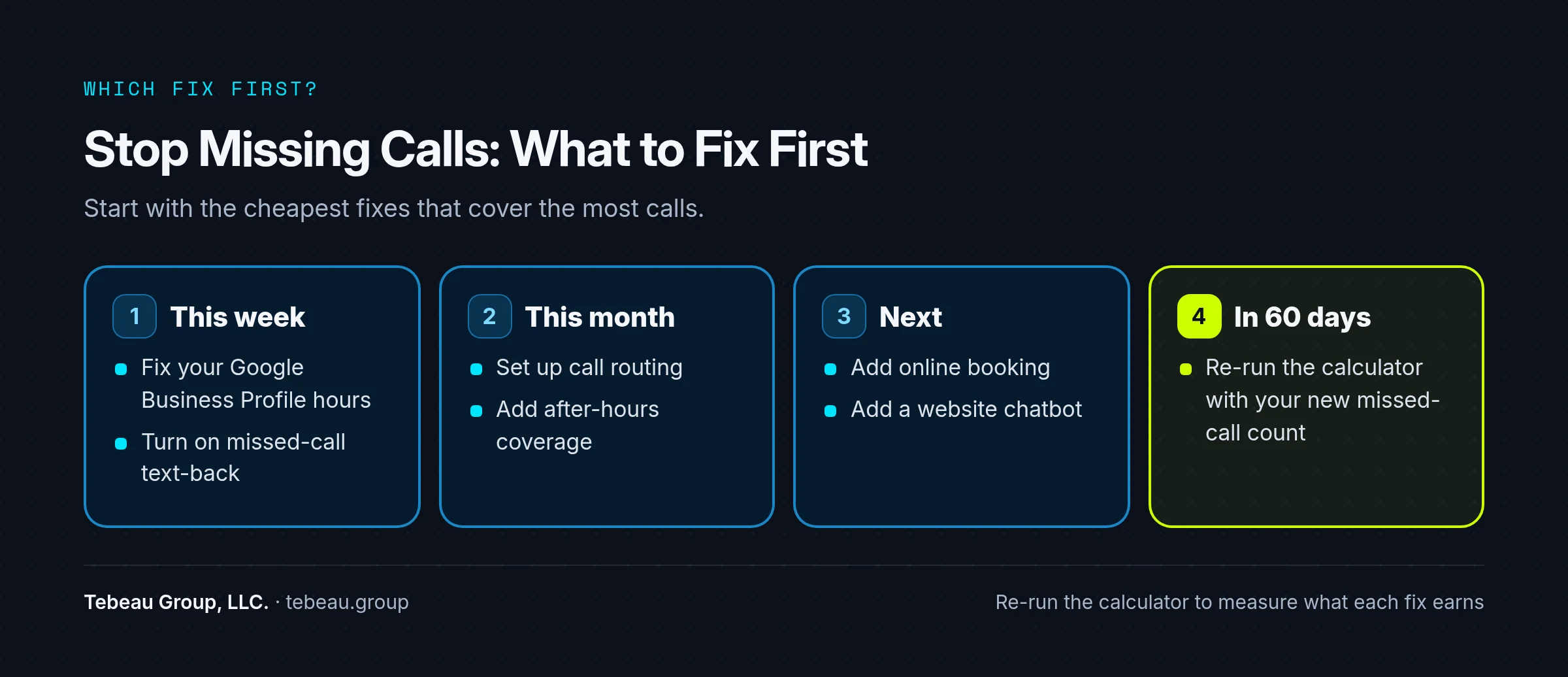
Here's the order:
- This week: Fix your Google hours and turn on missed-call text-back.
- This month: Set up call routing and after-hours coverage.
- Next: Add online booking and a website chatbot.
Then re-run the calculator in 60 days with your new missed-call count. The difference is what the fixes are earning you. Our lead generation optimization service sets up the tracking so you can see it.
Frequently Asked Questions
How much do missed calls cost contractors?
It depends on your own numbers. Multiply missed calls per week by the share that were real jobs, your close rate and your average job value, then multiply by 52 for a yearly estimate.
How do I find out how many calls I'm missing?
Check the unanswered-call log in your phone system or carrier account. If you don't have one, add call tracking and measure for two weeks.
What is missed-call text-back?
An automatic text sent to anyone whose call you miss, so they can reply or book online instead of calling a competitor.
Is an AI receptionist worth it for a small contractor?
Run the calculator. If your after-hours missed calls cost more than the service, it's likely worth testing.
Do missed calls affect Google Local Services Ads?
Google says that if you regularly fail to answer calls or respond to messages, your Local Services ad ranking may be affected.
Stop Losing Jobs to Voicemail
Want help finding where your calls are slipping through? Call Tebeau Group, LLC. at (469) 955-0269 or get a free audit. We help home-services companies across Dallas–Fort Worth capture more calls, from our office at 825 Watters Creek Blvd, Bldg M, Suite 250, Allen, TX 75013.